Convert Uploaded File to Image Url Javascript
Prototype resizing is computationally expensive and usually done on the server-side so that correct-sized image files are delivered to the customer-side. This approach as well saves data while transmitting images from the server to the client.
Nevertheless, at that place are a couple of situations where you might demand to resize images purely using JavaScript on the client side. For example -
- Resizing images before uploading to server
Uploading a big file on your server will accept a lot of time. You can beginning resize images on the browser and so upload them to reduce upload time and improve application operation.
- Rich image editors that piece of work on client-side
A rich image editor that offers epitome resize, crop, rotation, zoom IN and zoom OUT capabilities frequently require paradigm manipulation on the client-side. The speed is critical for the user in these editors.
If a user is manipulating a heavy image, it will take a lot of time to download transformed images from the server. Imagine this with operations like undo/redo and circuitous text and image overlays.
Prototype manipulation in JavaScript is done using the canvas element. There are libraries similar material.js that offer rich APIs.
Apart from the above ii reasons, in most all cases, you would desire to get the resized images from the backend itself so that client doesn't take to bargain with heavy processing tasks.
In this post-
- Nosotros will starting time talk nearly how to do resizing purely in JavaScript using the
sailelement.
- And then we will embrace in bang-up detail how y'all tin can resize, ingather, and exercise a lot with images by irresolute the image URL in the
srcattribute. This is the preferred way to resize images without degrading the user feel programmatically.Also, nosotros will learn how you tin can do this without needing to fix any libraries or backend servers.
Image resizing in JavaScript - Using canvas element
The HTML <canvas> element is used to draw graphics, on the fly, via JavaScript. Resizing images in browser using canvas is relatively simple.
drawImage function allows u.s. to render and scale images on canvas element.
drawImage(image, x, y, width, height) The starting time argument prototype can be created using the Image() constructor, as well as using any existing <img> element.
Let'south write the code to resize a user-uploaded image on the browser side 300x300.
<html> <body> <div> <input type="file" id="image-input" have="image/*"> <img id="preview"></img> </div> <script> allow imgInput = certificate.getElementById('image-input'); imgInput.addEventListener('change', function (eastward) { if (e.target.files) { permit imageFile = due east.target.files[0]; var reader = new FileReader(); reader.onload = part (eastward) { var img = document.createElement("img"); img.onload = role (consequence) { // Dynamically create a sail element var canvas = document.createElement("canvas"); // var sail = certificate.getElementById("canvas"); var ctx = canvas.getContext("second"); // Bodily resizing ctx.drawImage(img, 0, 0, 300, 300); // Show resized paradigm in preview element var dataurl = canvass.toDataURL(imageFile.type); document.getElementById("preview").src = dataurl; } img.src = e.target.result; } reader.readAsDataURL(imageFile); } }); </script> </body> </html> Let's empathise this in parts. First, the input file blazon field in HTML
<html> <body> <div> <input blazon="file" id="image-input" take = "prototype/*"> <img id="preview"></img> </div> </body> </html> Now nosotros need to read the uploaded image and create an img element using Image() constructor.
let imgInput = document.getElementById('image-input'); imgInput.addEventListener('change', office (due east) { if (due east.target.files) { permit imageFile = e.target.files[0]; var reader = new FileReader(); reader.onload = function (e) { var img = document.createElement("img"); img.onload = role(event) { // Actual resizing } img.src = east.target.result; } reader.readAsDataURL(imageFile); } }); Finally, permit's draw the prototype on canvas and show preview chemical element.
// Dynamically create a canvas element var canvas = document.createElement("canvas"); var ctx = canvas.getContext("2d"); // Actual resizing ctx.drawImage(img, 0, 0, 300, 300); // Show resized image in preview chemical element var dataurl = canvas.toDataURL(imageFile.type); document.getElementById("preview").src = dataurl; You might notice that the resized image looks distorted in a few cases. It is because we are forced 300x300 dimensions. Instead, we should ideally merely manipulate one dimension, i.e., height or width, and adjust the other accordingly.
All this can be washed in JavaScript, since yous have access to input image original peak (img.width) and width using (img.width).
For example, we can fit the output image in a container of 300x300 dimension.
var MAX_WIDTH = 300; var MAX_HEIGHT = 300; var width = img.width; var height = img.peak; // Change the resizing logic if (width > height) { if (width > MAX_WIDTH) { height = height * (MAX_WIDTH / width); width = MAX_WIDTH; } } else { if (height > MAX_HEIGHT) { width = width * (MAX_HEIGHT / height); pinnacle = MAX_HEIGHT; } } var canvas = document.createElement("canvas"); canvas.width = width; canvas.height = pinnacle; var ctx = canvas.getContext("2d"); ctx.drawImage(img, 0, 0, width, pinnacle); Controlling image scaling behavior
Scaling images can result in fuzzy or blocky artifacts. There is a trade-off between speed and quality. By default browsers are tuned for better speed and provides minimum configuration options.
You can play with the following properties to control smoothing upshot:
ctx.mozImageSmoothingEnabled = false; ctx.webkitImageSmoothingEnabled = false; ctx.msImageSmoothingEnabled = false; ctx.imageSmoothingEnabled = false; Paradigm resizing in JavaScript - The serverless way
ImageKit allows you to manipulate prototype dimensions directly from the image URL and get the exact size or crop you want in real-time. Start with a single chief image, as large equally possible, and create multiple variants from the same.
For example, we tin create a 400 x 300 variant from the original image like this:
https://ik.imagekit.io/ikmedia/ik_ecom/shoe.jpeg?tr=w-400,h-300 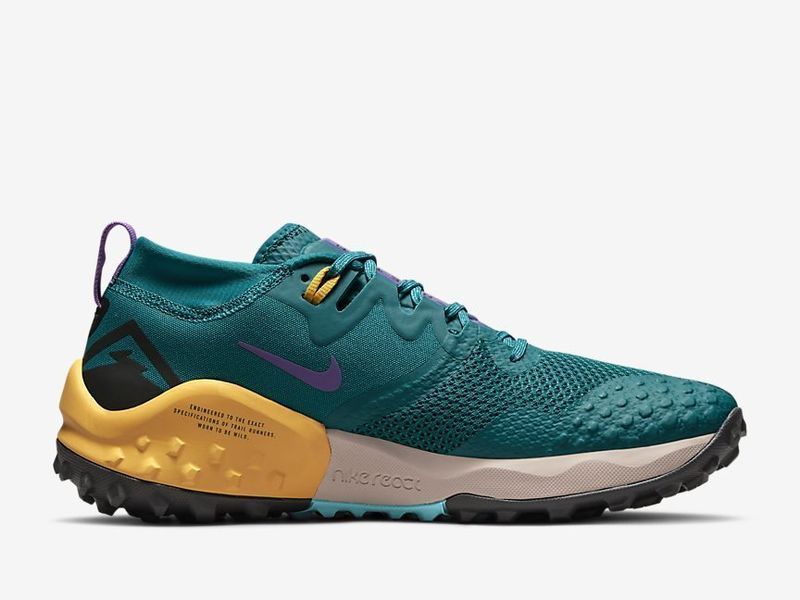
Yous tin use this URL directly on your website or app for the product image, and your users get the correct image instantly.
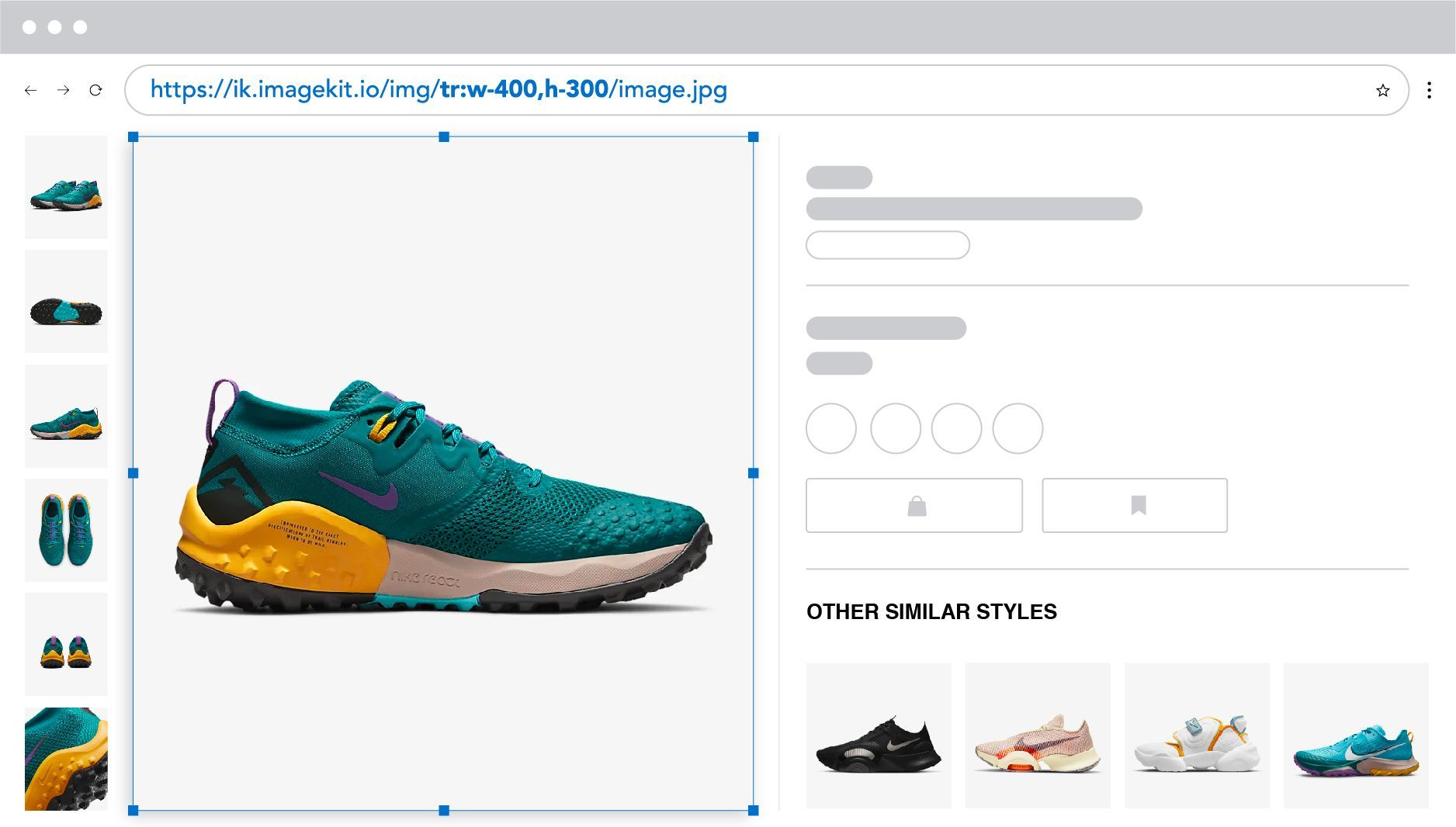
If yous don't want to ingather the image while resizing, there are several possible crop modes.
https://ik.imagekit.io/ikmedia/ik_ecom/shoe.jpeg?tr=w-400,h-300,cm-pad_resize,bg-F5F5F5 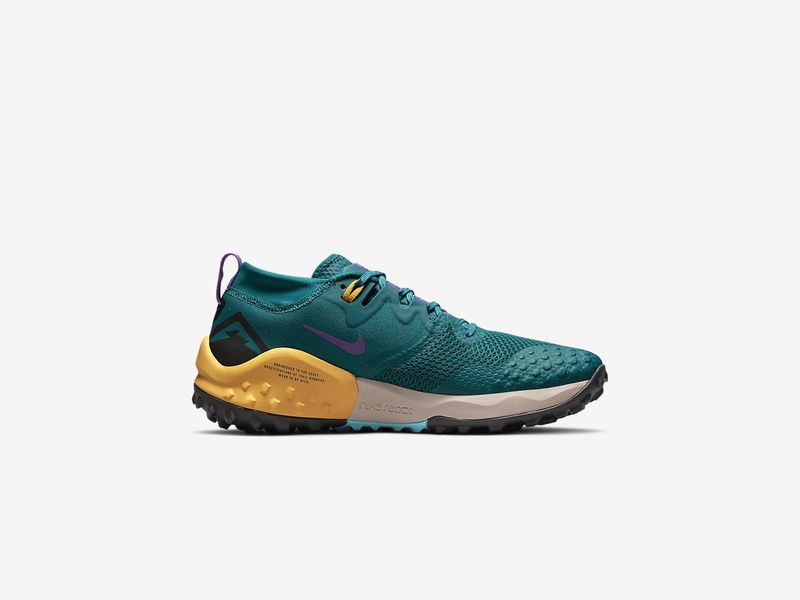
We have published guides on how you tin do the following things using ImageKit's real-fourth dimension image manipulation.
- Resize image - Basic peak & width manipulation
- Cropping & preserving the aspect ratio
- Face up and object detection
- Add together a watermark
- Add a text overlay
- Arrange for slow internet connectedness
- Loading a blurred low-quality placeholder
Summary
- In about cases, you should not do paradigm resizing in the browser considering it is slow and results in poor quality. Instead, you should employ an paradigm CDN like ImageKit.io to resize images dynamically past changing the image URL. Effort our forever gratuitous plan today!
- If your use-case demands client-side resizing, it is possible using the
canvaselement.
Source: https://imagekit.io/blog/how-to-resize-image-in-javascript/

Post a Comment for "Convert Uploaded File to Image Url Javascript"